
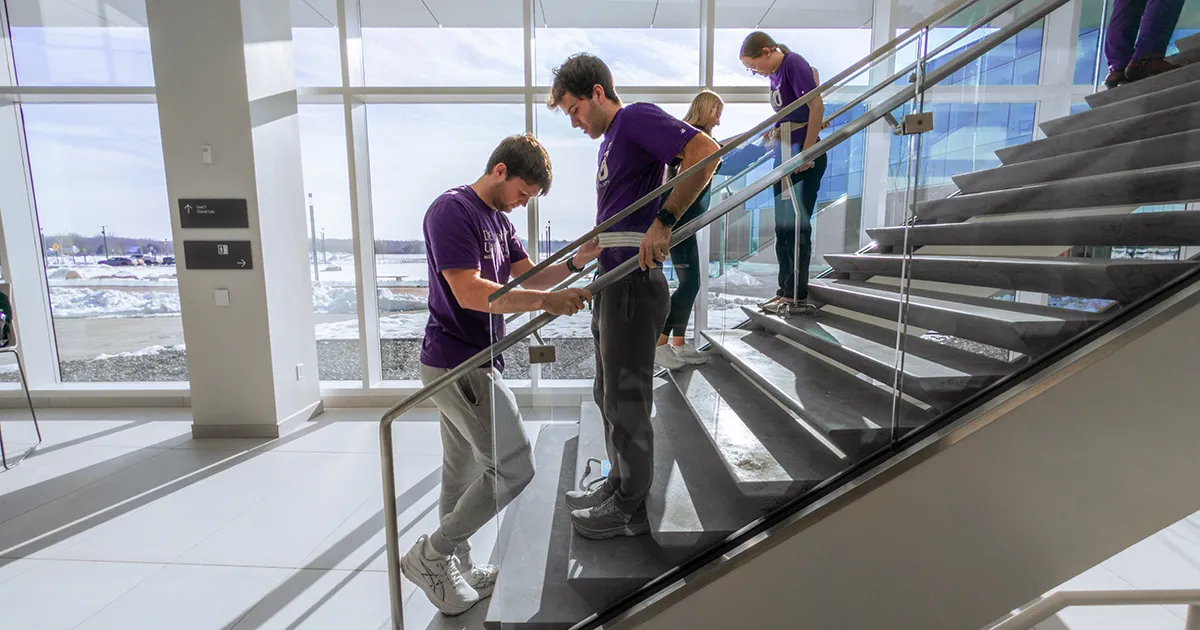
One Degree. Four Areas of Focus.
Students in the Doctor of Occupational Therapy program can choose from four concentration areas: general practice, pediatrics, rehabilitation or wellness. Whether you’re passionate about working with children, helping individuals recover from injury, promoting health and well-being or keeping your options open, DMU offers areas of focus that support your interests and professional goals.
Coursework That Prepares You for Practice
Our OTD curriculum spans 33 months across eight terms, combining progressive coursework with hands-on fieldwork to prepare you for compassionate, values-driven practice.
You’ll begin with foundational learning and Level I fieldwork, transition into immersive Level II fieldwork and finish with your Doctoral Capstone Experience and Project — each step building your skills, confidence and leadership.
Here are just a few things that make our fieldwork education unique:
- Five Level I fieldwork experiences — more than most programs offer.
- Level I fieldwork is integrated into coursework, so you apply your learning in real time.
- Our Central Iowa metro location gives you access to diverse fieldwork sites that reflect real-world OT environments.
- Two 12-week Level II fieldwork placements at over 300 sites across the U.S. and internationally.
- Design your own Doctoral Capstone, with opportunities to collaborate with global health partners or make a difference locally. Check out our institutional repository for more past OTD capstone works.
Scroll horizontally to see all columns.
|
Summer Term (June - July) |
Fall Term (August - December) |
Spring Term (January - May) |
|
|---|---|---|---|
| Year 1 |
18 Total Credits Functional Anatomy and Kinesiology (5 credits) Evidence-Based Occupational Therapy Practice (3 credits) Professional Reasoning 1 (1 credit) Foundations of OT (4 credits) Conditions Affecting Occupation (4 credits) Occupational Health & Wellness: Population Perspective (1 credit) |
18 Total Credits Professional Reasoning 2 (2 credits) Human Behavior & Lifespan Development (3 credits) OT Process 1: Evaluation (5 credits) Functional Neuroscience (4 credits) The OT Scholar 1 (2 credits) Care Coordination & Collaborative Practice (2 credits) |
|
| Year 2 |
9 Total Credits OT Process 2: Technology & Environmental Intervention (4 credits) OT Process 3: Preparatory Methods Intervention (5 credits) |
18.5 Total Credits NAMI Provider Education Program for O.T.D. (0.5 credit) Capstone Preparation 1 (1 credit) The OT Scholar 2 (2 credits) The OT Entrepreneur 1 (2 credits) OT Process 4: Psychosocial Intervention (4 credits) OT Process 5: Rehab, Disability & Participation Intervention 1 (3 credits) OT Process 6: Intervention for Children & Youth (6 credits) |
18 Total Credits Capstone Preparation 2 (1 credit) The OT Scholar 3 (2 credits) Professional Reasoning 3 (3 credits) The OT Entrepreneur 2 (2 credits) OT Process 7: Rehab, Disability & Participation Intervention 2 (4 credits) OT Process 8: Health, Wellness & Productive Aging Intervention (4 credits) Healthcare, Policy & Advocacy in OT (2 credits) |
| Year 3 |
13 Total Credits Level II Fieldwork A (12 credits) Capstone Preparation 3 (1 credit) |
14 Total Credits Level II Fieldwork B (12 credits) Capstone Preparation 4 (1 credit) The OT Practitioner (1 credit) |
15 Total Credits Doctoral Capstone Experience (14 credits) Doctoral Capstone Project (1 credit) |
One Cohort, Two Program Pathways
You can choose one of two pathways to earn your OTD degree. Both pathways are part of the same student cohort and follow the same full-time schedule. Students from both pathways will come together for weekly laboratory sessions.
Traditional Campus Pathway
Engage in most class and laboratory sessions face-to-face on campus. You’ll also have access to virtual class sessions when needed.
Hybrid Pathway
Engage in class sessions virtually (synchronously or asynchronously) and attend laboratory sessions face-to-face on campus. Laboratory sessions will generally occur two consecutive days per week. You’ll also have the option to attend class sessions face-to-face on the DMU campus periodically.
Expand Your Impact With Dual Degrees
As an OTD student, you can pursue a dual degree from DMU in:
We also offer 3+3 partnerships with Grand View University, the University of Northern Iowa and others, allowing you to earn your bachelor’s degree and OTD on an accelerated timeline.
Stand Out With Your Expertise
Build your resume while still an OTD student with embedded certifications and advanced trainings, including:
- Basic Life Support
- CITI Training (Basic Research, Social-Behavioral, HIPAA)
- Diversity Health Series
- Green Bandana Suicide Prevention
- Iowa Adverse Childhood Experiences (ACEs) Trauma Training
- Mandatory Reporter for Children and Adult
- Mental Health First Aid
- National Alliance on Mental Illness Provider Education
- SafeZone Training
- Seizure Recognition and First Aid
- Team STEPPS
Additional certifications offered at a reduced rate may include:
- DIRFloortime
- Kinesiotaping
- Lee Silverman Voice Treatment
- Mandt Training
- Sexuality in OT
- SOS Approach to Feeding
Degree Completion Timeframe
In accordance with the Satisfactory Academic Progress Policy for Financial Aid, all coursework for the Doctor of Occupational Therapy degree must be completed within 150% of the stated program length, or 4.5 years, beginning with enrollment in the first course.
The didactic portion of the program is approximately 2 years (22 months). Students must then complete 24 weeks of Level II fieldwork as well as an individual 14-week capstone experience within 24 months following the completion of the didactic portion of the program. The doctoral capstone experience must be started after completion of all coursework and Level II fieldwork as well as completion of preparatory activities defined in 2023 ACOTE OTD Standard D.1.3.