
Coursework That Prepares You for Practice
The Doctor of Podiatric Medicine program prepares you for a successful career in podiatric medicine through a curriculum that combines classroom learning, hands-on labs and clinical experiences in hospitals and ambulatory care settings.
You’ll take foundational science courses alongside College of Osteopathic Medicine students in your first year. As you progress, your studies will shift toward foot and ankle care and developing physical diagnosis skills.
During your second year, you’ll dive deeper into clinical medicine and basic sciences with a focus on the lower extremity. You’ll explore how body systems work together, while building expertise in biomechanics, lower limb anatomy, clinical podiatric medicine, diagnosis and surgery.
By your third year, you’ll apply evidence-based medicine using the latest clinical research to make informed decisions about patient care. You’ll engage in case discussions and research, building on everything you’ve learned to prepare for real-world clinical training.
Put Your Degree to Work
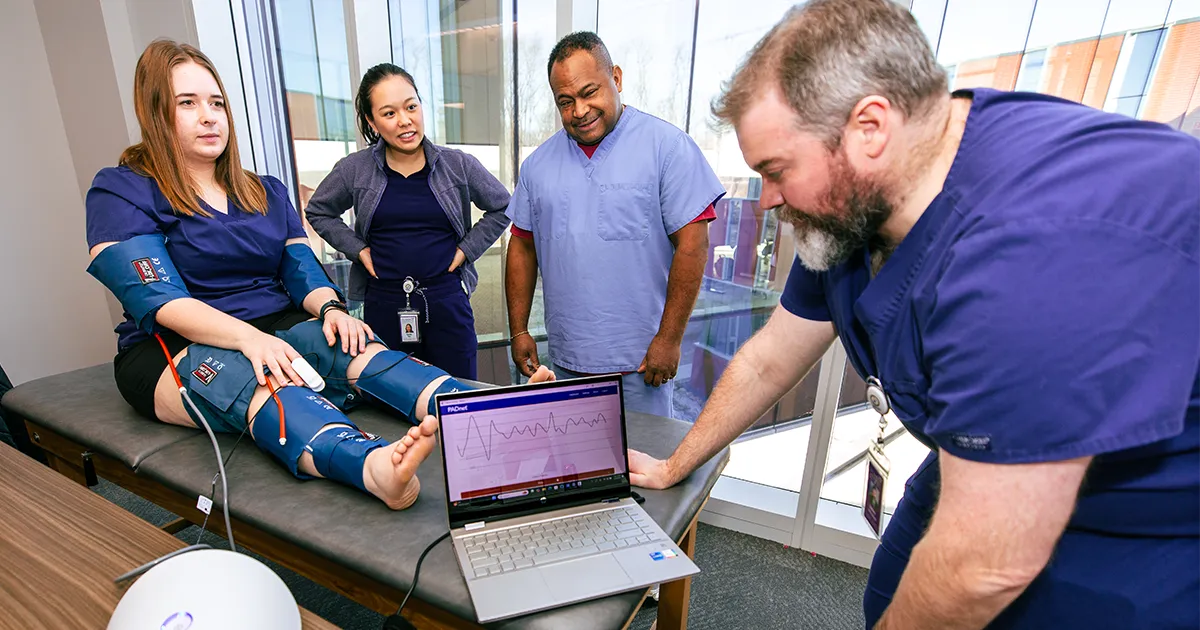
In your second year, you’ll have the opportunity to practice physical diagnosis skills. Formal clinical rotations begin the summer after your second year and continue through graduation, giving you hands-on experience in a variety of settings — from foot and ankle care in the Des Moines University Clinic to fourth-year rotations available nationwide.
After graduation, you’ll enter a three-year residency program at one of many locations across the country. While specific placements can’t be guaranteed, many DMU graduates match with prestigious teaching hospitals, and podiatric physicians go on to practice in a wide range of clinical environments.
Scroll horizontally to see all columns.
|
Fall Term (August – December) |
Spring Term (January – May) |
Summer (June – July) |
||
|---|---|---|---|---|
| Year 1 |
Anatomy I Clinical Medicine I A Foundational Sciences I Principles and Practices of Podiatric Med |
Winter Break |
Anatomy II Clinical Medicine I B Foundational Sciences II Foundational Sciences III |
|
| Year 2 |
CS I: Cardio/Pulmonary CS II: Endo/Hematology CS III: Neph/Gi/Nutrition CS IV: Neuro/Beh Med Cultural Competency in Medicine Lower Extremity Dermatology Medical Pharmacology |
Winter Break |
Biomechanics and Surgery Clinical Medicine and Diagnostics Fundamentals of Foot Function Geriatrics Lower Limb Anatomy |
Clinical Rotations (May – July) |
| Year 3 |
Basic Surgical and Medical Skills Heath Care Systems, Community Med, Jurisprudence Trauma |
|||
|
Clinical Rotations (July – May) Evidence-Based Medicine (September – April) |
Year 4 Begins | |||
| Year 4 |
Clinical Skills Assessment (Taken in 1-Credit Hour Increments Over Three Terms) Clinical Rotations (44 Credit Hours) |
|||
Broaden Your Impact With a Dual Degree
As a student in the DPM program, you may be eligible to pursue a dual degree in one of DMU’s graduate programs, such as the Master of Public Health, Master of Health Care Administration, Master of Science in Biomedical Sciences, Master of Science in Anatomy or the Doctor of Philosophy in Biomedical Sciences.
These programs allow you to expand your expertise beyond clinical practice by advancing your leadership skills, deepening your knowledge in public health or contributing to academic medicine and research.
We also offer partnerships with select undergraduate institutions, allowing you to earn your bachelor’s degree and DPM on an accelerated timeline.
Learn More in the Academic Catalog