
Coursework That Prepares You for Practice
The Doctor of Physical Therapy program at Des Moines University Medicine and Health Sciences delivers a distinctive, evidence-based curriculum focused on patient-centered care and lifelong learning.
Over 29 months, you’ll engage in a blended curricular format that integrates classroom and clinical instruction, emphasizing critical thinking, problem-solving and manual therapy techniques used to treat dysfunctions across the musculoskeletal, neuromuscular and cardiopulmonary systems.
Competency-based assessments aligned with the 12 Entrustable Professional Activities guide your development in patient evaluation, clinical decision-making, interprofessional collaboration and evidence-informed intervention — ensuring you are ready for contemporary physical therapy practice.
Get Hands On
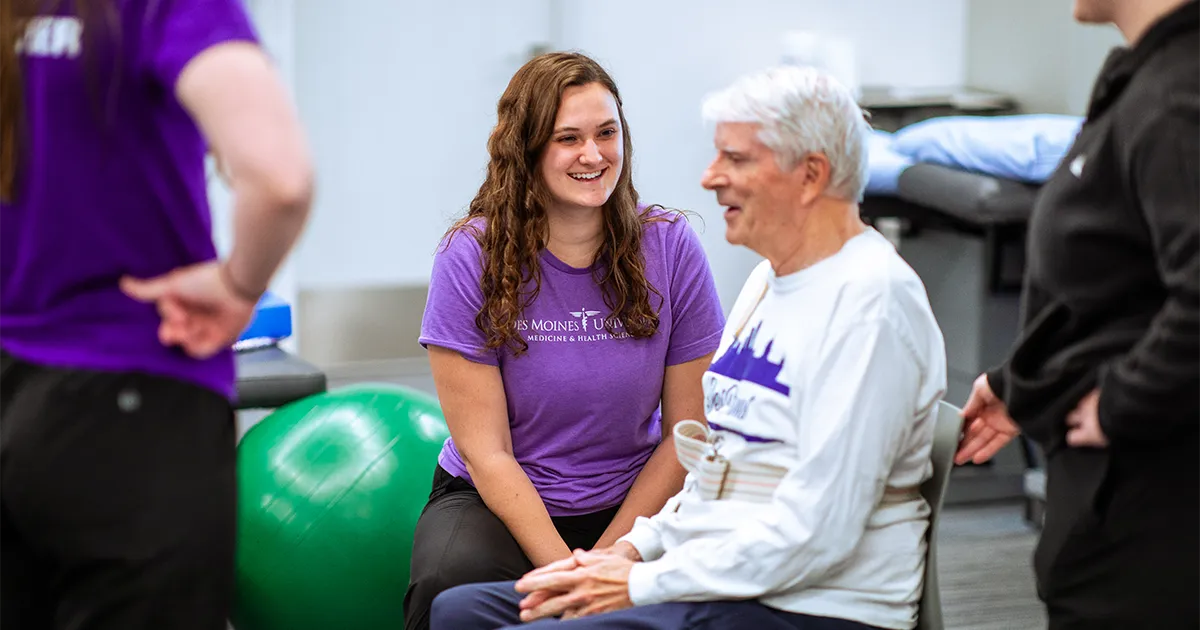
A hallmark of our program is early clinical exposure through four integrated clinical education experiences:
- Half-day placements aligned with your coursework
- Located in hospitals, clinics and community settings within an hour of campus
- Real-world application of knowledge while developing professional behaviors and clinical skills
You’ll also complete:
- Three full-time clinical education experiences totaling 30 weeks
- Required rotations in outpatient, inpatient and elective settings
- Training at sites with long-standing DMU partnerships, where students are consistently praised for their clinical readiness and manual therapy expertise
Scroll horizontally to see all columns.
|
Summer Term (June - July) |
Fall Term (August - December) |
Spring Term (January - May) |
|
|---|---|---|---|
| Year 1 |
16.5 Total Credits Professional Practice & Research Methods (4 credits) Human Movement (4 credits) Musculoskeletal Anatomy (4.5 credits) Kinesiology (4 credits) |
18 Total Credits Wellness, Health & Evidence Based Practice (4 credits) Neural Basis of Human Movement (3 credits) Integrative Visceral Systems & Systems Review (5 credits) Physical Therapy Examination & Evaluation (4 credits) Professional Practice Topics (2 credits) |
|
| Year 2 |
10.5 Total Credits Manual Therapy & Biophysical Agents (4.5 credits) Therapeutic Exercise (3 credits) Integrated Practice (3 credits) |
17 Total Credits Clinical Education Experience 1 (10 credits) Pharmacology & Imaging (3 credits) Pathophysiology & Integumentary (4 credits) |
18 Total Credits Contemporary Professional Practice (3 credits) Evidence Based Practice - Outcomes (2 credits) Advanced Neuromuscular Interventions (3 credits) Clinical Education Experience 2 (10 credits) |
| Year 3 |
10.5 Total Credits Practice Management (2.5 credits) Pediatrics (2 credits) Adaptive & Assistive Technologies (2 credits) Management of the Complex Patient (4 credits) |
17.5 Total Credits Preparation for Clinical Practice (3 credits) Complex Movement Analysis (2 credits) Integrated Manual Therapy (2.5 credits) Clinical Education Experience 3 (10 credits) |
|
Expand Your Impact With Dual Degrees
As a DPT student, you can broaden your career opportunities by pursuing a dual degree in one of DMU’s graduate programs, including the Master of Public Health or Master of Health Care Administration.
These programs allow you to expand your expertise beyond clinical practice by advancing your leadership skills or deepening your knowledge in public health.
Master of Public Health
Offered entirely online, the MPH program equips you with the skills to lead community health initiatives and address population-level health challenges. Courses focus on identifying, preventing and resolving public health issues across diverse communities.
Master of Health Care Administration
Also fully online, the MHA program helps you build leadership and management expertise while expanding your understanding of the health care delivery system — ideal for those interested in administrative or operational roles in health care.