
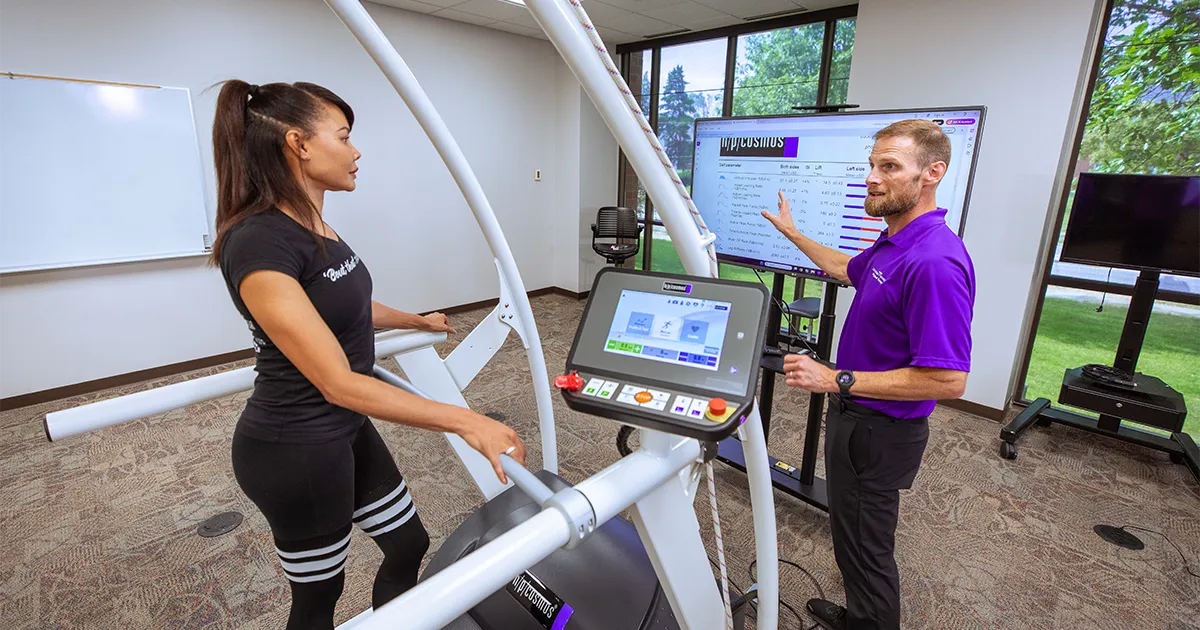
As a student in the Doctor of Physical Therapy program at Des Moines University Medicine and Health Sciences, your learning extends into portable motion capture equipment and two dedicated research laboratories designed to advance the science of movement and rehabilitation.
Through hands-on work including our specialized labs — the Human Performance Laboratory and the Motor Control Laboratory — you’ll have the opportunity to engage in faculty-led research, explore cutting-edge technology and contribute to projects that inform evidence-based physical therapy practice. These experiences refine your analytical thinking, broaden your understanding of human performance and prepare you to deliver innovative, data-driven care.
Human Performance Laboratory
Push Boundaries and Improve Performance
The Human Performance Laboratory blends biomechanics, research and clinical insight to understand how the body moves — and how to improve movement and function. From injury rehabilitation and prevention to enhancing movement efficiency in daily, recreational, athletic and work settings, the lab provides the tools and mentorship to explore the “how” and “why” behind human performance.
Faculty Mentors





Research That Makes a Difference
As a DMU student, you’ll work alongside faculty who are passionate about discovery, education and mentorship. In the Human Performance Lab, you’ll help deepen scientific knowledge, publish meaningful findings and translate research into practical solutions for patients, athletes and everyday movers.
Ongoing research covers topics like:
- Movement mechanics in orthopedic and neurological conditions
- Joint loading and muscle activation during various tasks
- Performance optimization and injury prevention
- Workplace ergonomics and workstation design
Tools That Turn Motion Into Insight
You’ll get hands-on with advanced movement analysis tech in the human performance lab. Here’s what you’ll work with and why it matters:
AMTI Force Platforms
In-Shoe and Pressure Platform Systems
Noraxon Portable Motion Analysis Lab With MyoResearch Software
Optical 3D Motion Analysis System
Ultrasound Imaging
Wireless Electromyography
Motor Control Laboratory
Explore Human Movement and Balance
The Motor Control Laboratory investigates how people move — and what happens when movement is disrupted by aging, neurological conditions or injury. Students study real‑world challenges such as balance difficulty, gait disorders and fall risk, working with faculty to advance rehabilitation strategies.
Faculty Mentors

Research You Can Be a Part Of
Join faculty-led projects that explore movement challenges such as:
- Why does the perception of balance affect the way people change directions when walking?
- How can neuromodulation change movement for people with Parkinson’s disease?
- Can manual therapy change spinopelvic alignment?
- What tools can clinicians use to evaluate and detect concussions in athletes and older adults?
Students often contribute to publications and may participate through research electives or the Mentored Student Research Program.
Tools to Help You See Movement
In the Motor Control Lab, you’ll use advanced technology that gives you a window into how people move and what happens when things go wrong. You won’t just study movement. You’ll measure it, test it and improve it — with tools used in top clinical and research settings:
APDM Mobility Lab System
Biodex RTM 600 Treadmill
Lafayette Handheld Dynamometer
Zenometrics Instrumented Walkway With Analysis Software
Other Motion Analysis Resources
You’ll have access to additional motion analysis equipment on campus and at the Des Moines University Clinic, giving you more opportunities to apply what you’re learning and study human movement across classroom, laboratory, clinical and real‑world environments.