
Your Degree, Your Way
The Doctor of Philosophy in Biomedical Sciences at Des Moines University Medicine and Health Sciences is a four-year, 86-credit program designed to give you both depth and flexibility. You’ll complete:
- 40 credit hours of research, where you’ll explore real-world biomedical challenges.
- 46 credit hours of coursework, including discipline-specific content, dissertation proposal development and defense.
The curriculum is built to help you:
- Build a strong foundation in biomedical science.
- Develop critical thinking and analytical research skills.
- Practice responsible research conduct.
- Strengthen scientific communication and grantsmanship.
- Customize your learning with additional coursework tailored to your area of study.
Most coursework is completed in the first two years, with seminars and specialized content continuing throughout the program. From the start, you’ll choose your area of study and collaborate in an interdisciplinary environment alongside faculty, fellow PhD candidates, medical students and more.
Research That Matters
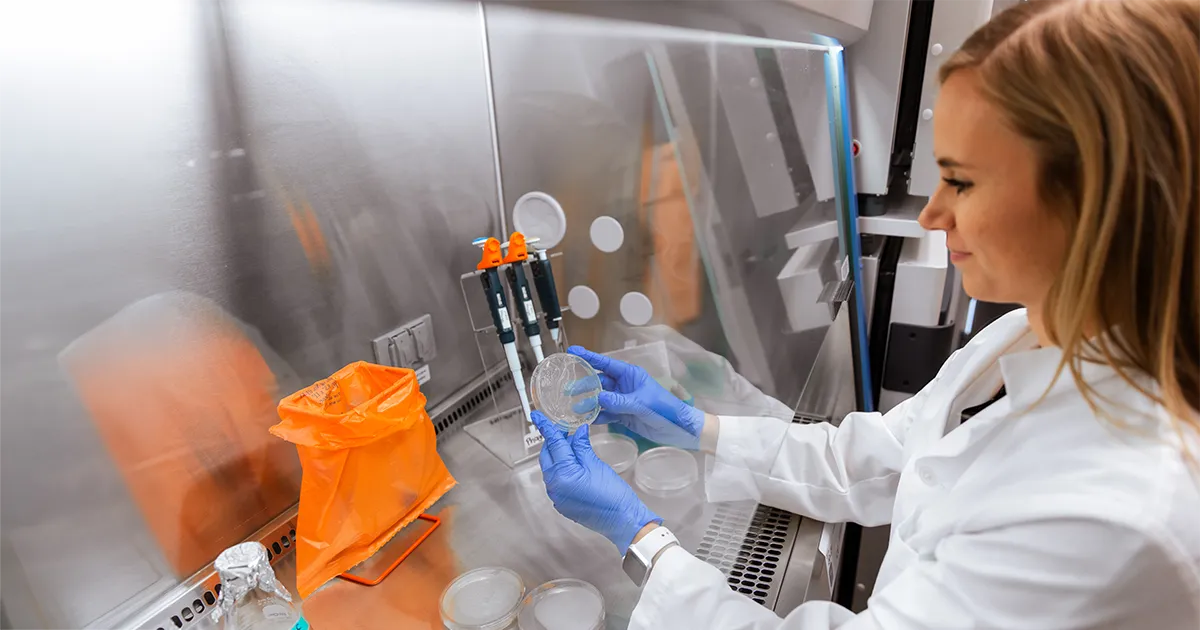
At DMU, your research makes a difference. You’ll collaborate with leading investigators on projects tackling critical health issues like brain tumors, cardiovascular disease, mood disorders, obesity, prostate cancer and more. With our intentionally small program size, you’ll have the flexibility to contribute to multiple projects and gain broad, hands-on experience across disciplines.
You’ll also train using advanced techniques such as electrophysiology, multi-probe intracellular imaging systems, biosensor development and targeted brain region analysis, all within cutting-edge lab spaces designed to support your success.
Expand Your Impact with Dual Degrees
Students enrolled in DMU’s Doctor of Osteopathic Medicine or Doctor of Podiatric Medicine programs can pursue a dual degree through the Doctor of Philosophy in Biomedical Sciences program, earning a DO/PhD or DPM/PhD.
This unique pathway is designed to train future physician-scientists who combine clinical expertise with advanced research skills. Graduates are prepared for careers that blend medical practice with scientific discovery across academic, industry and government settings.
How the Dual Degree Works
The program follows a 2-3-2 structure:
- Years 1–2: Complete DO or DPM coursework
- Years 3–5: Focus on PhD research and training
- Years 6–7: Return to complete the DO or DPM curriculum
During the PhD phase, students receive a tuition waiver and annual stipend, paying only for living expenses. The DO/DPM tuition applies during the first and final two years.
Students apply to the PhD program during the fall term of their second year in the clinical program. If accepted, they begin PhD coursework the following summer, having already completed 16 shared credit hours between the DO/DPM and PhD curricula.
Program Mission, Vision and Learning Outcomes
Mission
To train the next generation of biomedical scientists or physician-scientists who will improve human lives via contributions to scientific breakthroughs.
Vision
The PhD program at DMU will be recognized as a high-quality doctoral program that broadly trains biomedical scientists and physician-scientists.
Learning Outcomes
The following learning outcomes describe the values and skills that are demonstrated by graduates of DMU’s Doctor of Philosophy in Biomedical Sciences:
- Apply knowledge of scientific theories and approaches to address important questions in their specific area of study.
- Critically assess hypotheses, study designs and experimental outcomes to achieve high-quality results.
- Demonstrate high standards of research conduct in biomedical sciences.
- Apply strong analytical skills to gain high-quality research data in biomedical sciences.
- Demonstrate strong scientific communication skills and grantsmanship.