
Accreditation Status
Des Moines University Medicine and Health Sciences is accredited by the Higher Learning Commission. See University Accreditation for more information.
The entry-level occupational therapy doctoral degree program is accredited by the Accreditation Council for Occupational Therapy Education (ACOTE) of the American Occupational Therapy Association (AOTA), located at 7501 Wisconsin Avenue, Suite 510E, Bethesda, MD 20814. ACOTE’s telephone number c/o AOTA is 301-652-AOTA and its web address is www.acoteonline.org.
Graduates of the program will be eligible to sit for the national certification examination for the occupational therapist administered by the National Board for Certification in Occupational Therapy (NBCOT). After successful completion of this exam, the individual will be an Occupational Therapist, Registered (OTR). In addition, all states require licensure to practice; however, state licenses are usually based on the results of the NBCOT Certification Examination. A felony conviction may affect a graduate’s ability to sit for the NBCOT certification examination or attain state licensure.
Program Mission, Vision and Values
Mission
To support the health, wellbeing and occupational engagement of people, communities and populations by preparing compassionate and competent leaders in occupational therapy.
Vision
We envision the DMU OTD program will be national leaders in occupational therapy education by engaging in scholarship, serving the local and global community, and creating therapists who are competent, collaborative and innovative.
Core Values
To fulfill its mission and advance toward its vision, the DMU OTD program seeks to prepare occupational therapists who value:
- Evidence-based and competent expertise in occupation
- Reflection, collaboration, compassion and professionalism
- Inclusion, diversity, culturally responsiveness and justice
- Ethical and intentional decision making
- Lifelong learning
- Holistic wellness, social responsibility and health equity.
Degree Completion Timeframe
In accordance with the Satisfactory Academic Progress Policy for Financial Aid, all coursework for the Doctor of Occupational Therapy degree must be completed within 150% of the stated program length, or 4.5 years, beginning with enrollment in the first course.
The didactic portion of the program is approximately 2 years (22 months). Students must then complete 24 weeks of Level II fieldwork as well as an individual 14-week capstone experience within 24 months following the completion of the didactic portion of the program. The doctoral capstone experience must be started after completion of all coursework and Level II fieldwork as well as completion of preparatory activities defined in 2023 ACOTE OTD Standard D.1.3.
OTD Curriculum Design
Our curriculum has been intentionally designed to create occupational therapists who are competent, ethical, culturally responsive, evidence-based and collaborative scholars and leaders, prepared to engage in lifelong learning, advance the profession and support health for all.
As a program built with a spiral curriculum, DMU's OTD promotes a deepening of understanding and skills through successive encounters and building of content (Bruner, 1960; Harden & Stamper, 1999). The value of a spiral curriculum is that there is consistent reinforcement, movement from simple to complex, repetitive and progressive development of concepts, and ongoing application and integration. Occupational therapy practice is not compartmentalized nor is it simple and straightforward. Thus, occupational therapy education calls for an innovative and contemporary curriculum which prepares students in a way that is reflective of their future practice.
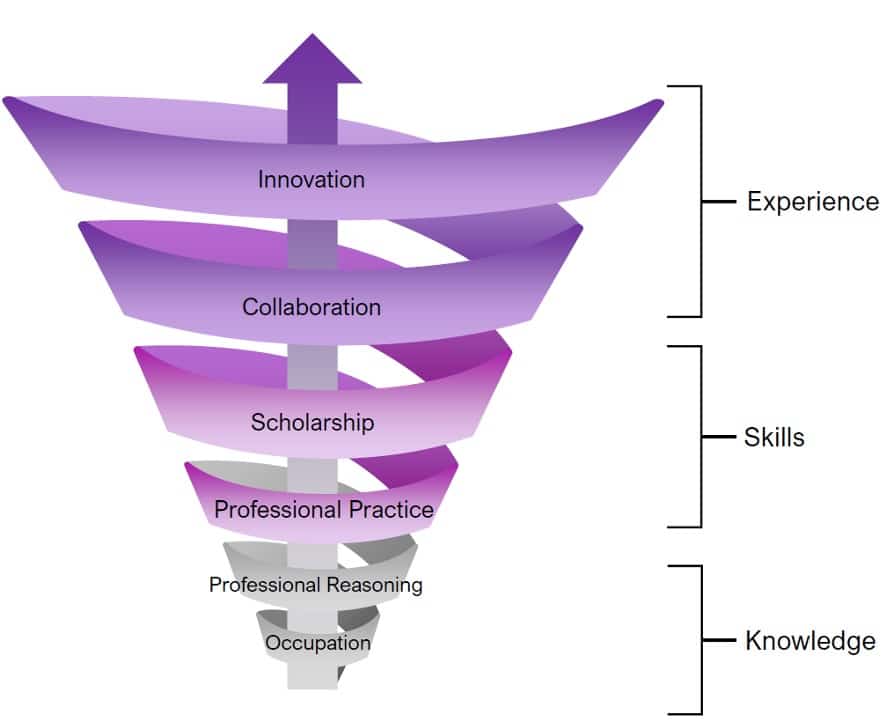
Within the DMU OTD curriculum, courses are set up in a logical sequence to promote your learning and success. There are three phases to the curriculum: Knowledge, skills and experience. Within these phases, our six themes guide how our curriculum is spirally integrated: Occupation, professional reasoning, professional practice, scholarship, collaboration and innovation.
The OTD curriculum at DMU focuses on equipping you, future occupational therapists, with the knowledge, skills and experiences needed to be effective and successful occupational therapists. You'll be prepared to serve individuals, communities and populations across the lifespan and in a variety of settings. The curriculum focuses on what is current in the field of occupational therapy as well as the future of the profession so that when you graduate, you're prepared to enter both traditional and emerging areas of practice that fit well with your needs, skills and interests.
References
Bruner, J. S. (1960). The Process of Education. Harvard University Press.
Harden, R. M., & Stamper, N. (1999). What is a spiral curriculum? Medical Teacher, 21(2), 141-143.
Program Philosophy
What View of Occupational Therapy Informs DMU’s OTD Curriculum?
What Are Our Fundamental Beliefs About Human Beings and How They Learn?
References
American Occupational Therapy Association. (2020). Occupational Therapy Practice Framework: Domain and Process- Fourth Edition. American Journal of Occupational Therapy, 74(Suppl_2), 7412410010p1–7412410010p87. https://doi.org/10.5014/ajot.2020.74S2001
American Occupational Therapy Association. (2017). Philosophical base of occupational therapy. American Journal of Occupational Therapy, 71(Suppl. 2), 7112410045. https://doi.org/10.5014/ajot.2017.716S06
Fink, L. D. (2013). Creating significant learning experiences. Jossey-Bass.
World Federation of Occupational Therapy. (2021). About occupational therapy. https://www.wfot.org/about/about-occupational-therapy