

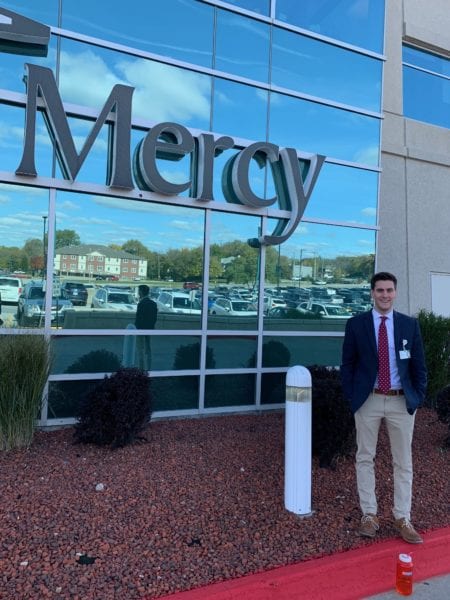
Christopher Brady and Nikolas Pappas share an excitement for the managerial and administrative aspects of health care. The two 2019 graduates of DMU’s master of health care administration (M.H.A.) program are now observing and experiencing a wide spectrum of these aspects in administrative fellowships – Chris, with MercyOne, and Nik, with the Iowa Clinic.
“As a new M.H.A. graduate, I was attracted to the fellowship because it’s giving me exposure to a wide range of high-level initiatives I wouldn’t have gotten elsewhere,” Nik says.
Adds Chris: “I get to work on a lot of projects and attend board meetings and leadership council meetings, where I listen to how their members handle situations. I’m in the corner, but I’m sitting at the grownups’ table.”
DMU’s M.H.A. program is a member of the National Council on Administrative Fellowships, which allows students to apply for these highly competitive postgraduate programs through a centralized application system.
“As a result, we’ve seen an increase every year in the number of students who apply for administrative fellowships,” says Rachel Reimer, Ph.D., associate professor and chair of the department of public health, which houses DMU’s M.H.A. and master of public health degree programs. “Our faculty and staff encourage students to apply.”
Leaders of the American College of Healthcare Executives consider administrative fellowships to be critical to the health care administration profession. They offer immersive, hands-on learning experiences that equip fellows to advance in careers tasked with managing the ever-increasing complexity of health care. Fellows learn about and manage projects in areas including executive leadership, human resources, finance, data management and technology and, of course, the delivery of care.
“It’s a good way to find my niche in health care,” Chris says.
Fellowships also allow participants to dig deep into different kinds of health care organizations. MercyOne, for example, is the largest health care organization in Iowa, with clinics and hospitals and more than 20,000 people.
“We have the only tertiary level three hospital in Des Moines,” Chris says. “We have a lot of rural affiliates. Every market MercyOne is in is a little different, so it will be cool to see that.”
Nik interviewed for a handful of fellowship programs but liked the Iowa Clinic best. “It’s physician-owned, so the administrative staff work hand in hand with the physicians,” he says. “I’m getting experience in communicating with them, honing my interprofessional skills.”
Chris and Nik praise DMU’s M.H.A. program for preparing them for their fellowships. “Now I have opportunities to apply what I learned because I’m working in an actual health care organization,” Nik says. “I’m getting a lot of good mentorship at the Iowa Clinic. They gauge how I’m doing. They don’t let you fail.”
Beyond the great advantages that fellowships provide to participants, they offer significant benefits to the organizations that offer them, from training potential new leaders to diversifying their workforce.
“These bright, aspiring leaders are able to explore interests and develop organizational knowledge, while learning from – and building relationships with – experts from Iowa’s largest health system,” says Karl Keeler, president of MercyOne Central Iowa and himself a former fellow. “MercyOne continues to benefit from the creativity, skill and dedication of our administrative fellows and often recruits them to stay at MercyOne and in central Iowa.”
Nik, who completed his field-based learning project for his M.H.A. degree at the Iowa Clinic, says fellows “bring new blood” to health organizations. “We offer an injection of new perspectives and theories that are being taught, while they can groom me for leadership roles,” he says.
Want to learn more about administrative fellowships in health care? Visit the American College of Healthcare Executives website, which provides a list of available postgraduate programs. Or visit the site of the National Administrative Fellowship Centralized Application Service (NAFCAS), which is the centralized application service for such programs.