
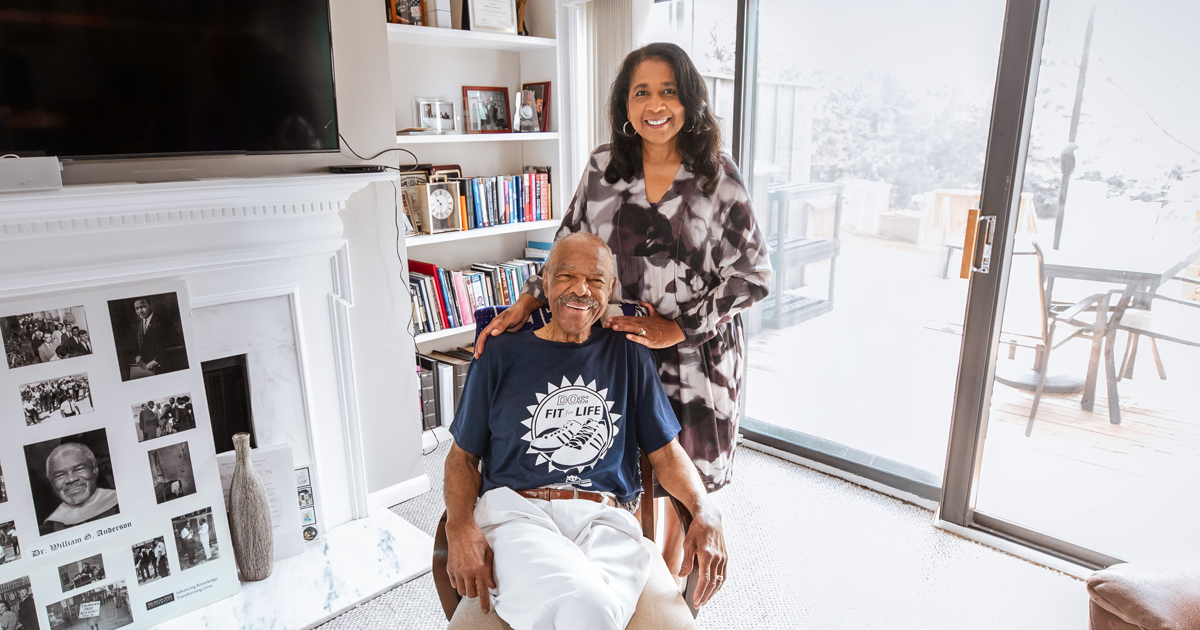

William G. Anderson, DO’56, was a civil rights leader, osteopathic physician, surgeon, educator and hospital administrator whose life’s work expanded opportunity, challenged injustice and strengthened the medical profession. A pioneer in both medicine and social change, Anderson leaves a legacy defined by courage and service to others.
Anderson was born on Dec. 12, 1927, and passed away on Aug. 16, 2026, at the age of 98.
“Dr. Anderson never quit. Throughout his life, his hard work, determination and fearless leadership broke barriers in medicine and across society,” says Angela L. Walker Franklin, PhD, president and CEO of Des Moines University Medicine and Health Sciences. “I feel fortunate to have known him and have always admired the example he set. Despite all he achieved, he remained generous with his time and was committed to DMU and our students. He inspired me and countless others around the world. A proud DMU alumnus, he was a lifelong supporter and champion of the university, and he always reflected the very best of our values.”
Anderson came of age during a time of profound inequality in the United States. After high school and an early enrollment at Fort Valley State College, his education was interrupted by World War II. In 1944, at just 17 years old, he enlisted in the U.S. Navy, where he served as a Hospital Corpsman. That experience solidified his resolve to become a physician and to dedicate his life to healing.
Following his military service, Anderson earned his undergraduate degree from Alabama State College for Negroes (now Alabama State University) in 1949. He went on to pursue medical training at Des Moines Still College of Osteopathy (now Des Moines University Medicine and Health Sciences), graduating in 1956 with a Doctor of Osteopathic Medicine degree and certification in surgery. He completed his internship at Flint Osteopathic Hospital in Michigan, a prestigious and formative step in his early career.
Anderson began practicing medicine and surgery in Albany, Georgia, where he served the community for six years. During this time, he also emerged as a central figure in the Civil Rights Movement. He was a founder and the first president of the Albany Movement, which spearheaded the fight for civil rights in Southwest Georgia. Working closely with close friends and fellow leaders Martin Luther King Jr. and Ralph D. Abernathy Sr., Anderson helped organize one of the most influential efforts for justice in the South. The Albany Movement’s work ultimately led to the desegregation of Albany’s public facilities and helped shape the national civil rights struggle.
After his work in Albany, Anderson returned to the practice of medicine, accepting an appointment as house physician at Art Centre Hospital in Detroit. In 1964, he made history as the first Black surgical resident in Detroit. He later established and maintained a group surgical practice in the city, where he served patients until 1984.
In the decades that followed, Anderson held numerous leadership roles in medical education and administration. He served as chair of the American Osteopathic Association’s Department of Education Affairs, as an advisor to the Michigan Health Care Education and Research Foundation, and as a clinical professor of surgery at the College of Osteopathic Medicine of the Pacific (now Western University of Health Sciences). He also served as an associate clinical professor at Michigan State University College of Osteopathic Medicine and as associate dean of the Kirksville College of Osteopathic Medicine in Missouri.
Anderson’s service to the American Osteopathic Association spanned more than two decades as a member of its board of trustees. In 1994, he became the first African American to serve as president of the AOA, a milestone that reflected both his leadership and his lifelong advocacy for diversity and inclusion within the profession. Over the course of his career, he received multiple honorary degrees from colleges and universities across the country, and he was later recognized as one of Becker’s Hospital Review’s 31 Black medical pioneers.
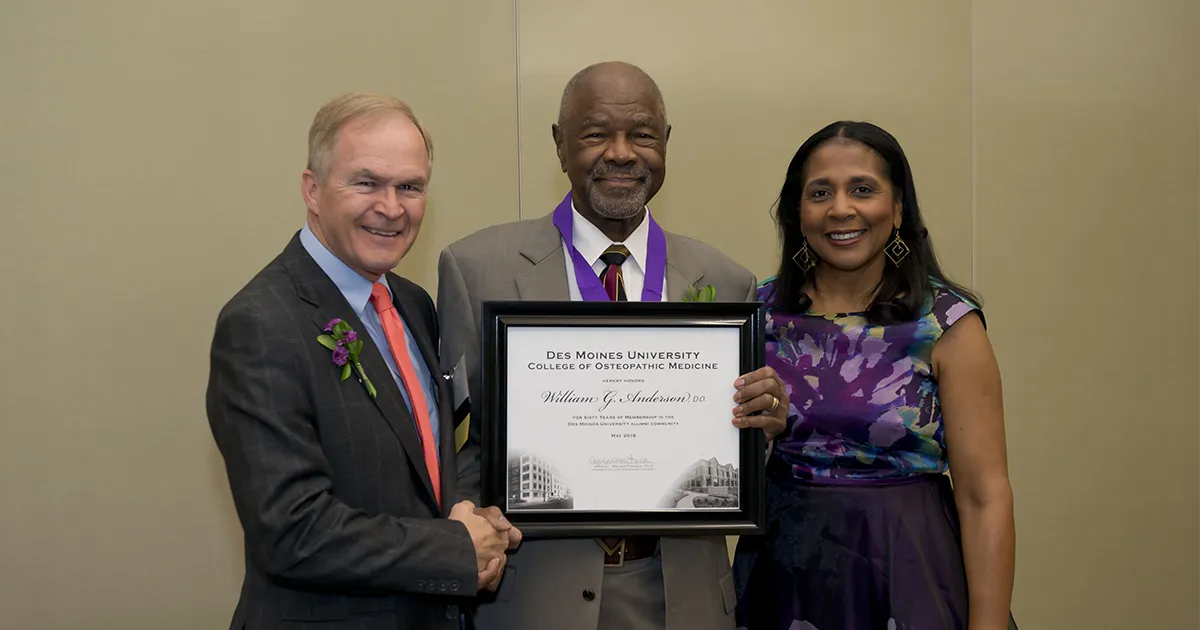
His connection to Des Moines University Medicine and Health Sciences remained strong throughout his life. Anderson served on the DMU Board of Trustees from 1973 to 1977 and was named an Emeriti Trustee in 1996. In 2009, the DMU Board of Trustees awarded him the Pioneer of Osteopathic Medicine Award — the university’s highest honor — bestowed upon only a handful of graduates.
Anderson’s life was marked by firsts: the first Black surgical resident in Detroit, the first Black president of the American Osteopathic Association, and a proud 1956 graduate of Des Moines University who helped open doors that had long been closed.