
DMU Researcher Jason Semprini Studies Iowa’s Nitrate Crisis
Iowa, the heartland of American agriculture, is facing a growing public health crisis that flows through its rivers and taps: nitrate contamination in its drinking water. This issue is driving one of the country’s highest and fastest-rising cancer rates and is increasingly linked to poor birth outcomes.
Jason Semprini, PhD, MPP, assistant professor of public health at Des Moines University Medicine and Health Sciences, focuses primarily on cancer prevention and control research but has recently shifted his focus to the immediate impacts of water quality, specifically the link between nitrates in drinking water and pregnancy-related outcomes.
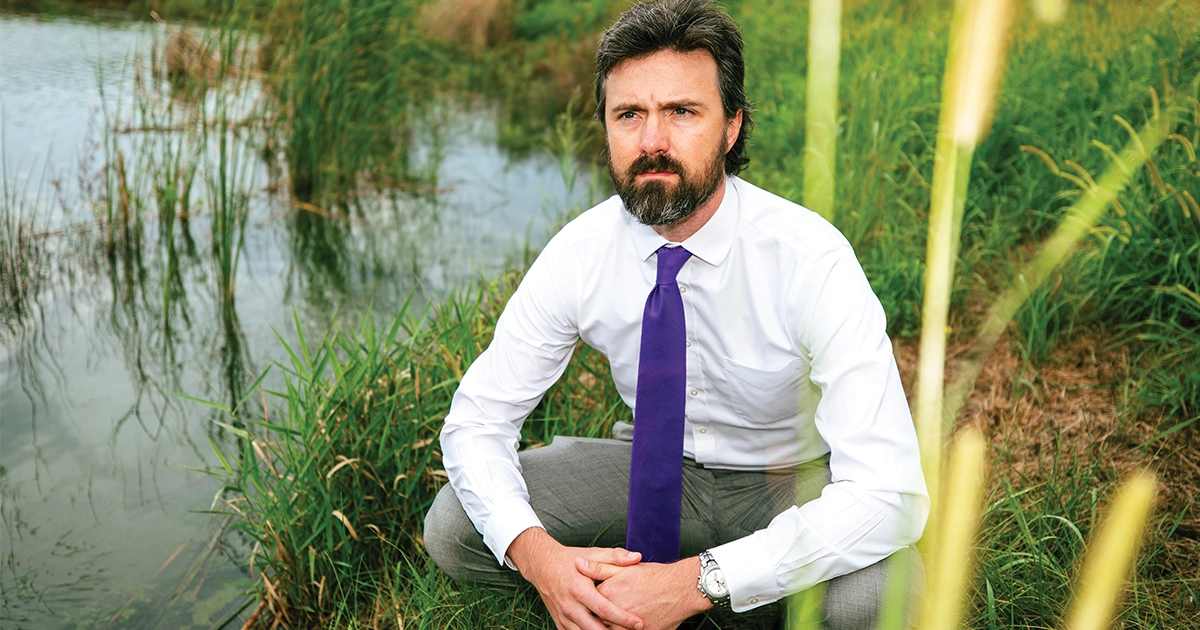
But last summer, when the Central Iowa Water Works issued its first-ever lawn watering ban due to high nitrate concentrations in its water sources, the media reached out to Semprini to answer questions that only scratched the surface. Could residents safely shower or swim? Was the water safe to drink? What are nitrates, and where did they come from?
The source of the problem, according to Semprini, was “upstream.” Nitrate contamination is largely a result of agricultural runoff, he said in interviews with local media. When excessive fertilizer is applied to farmland without protective measures, the water runs off into groundwater and rivers, eventually contaminating public and private drinking water supplies.
Semprini also noted a relevant combination of increased public awareness and the sheer cost and burden of treating high nitrates. The strain on the Des Moines nitrate removal facility was also an issue, but the public health impact of water quality brought into sharp focus residents’ need to know more.
“There’s been an appetite to really talk about what is causing high cancer rates in Iowa,” he says. “A lot of the public and our friends and neighbors want to know, ‘Is it the water? Is it the environment that’s causing this, and what can we do to solve it?’”
Semprini’s research found that the only effective, long-term solution is to address the source. This involves reducing the amount of fertilizer and runoff through different types of protective agricultural practices. However, he notes that in Iowa, these measures are mostly voluntary, and “not likely going to change farming practices.” Without more oversight or requirements, the problem will continue to burden the public health system and infrastructure.
Iowa’s Toxic Water and Its Impact on Babies
While studying cancer in relation to environmental factors is complex and time-consuming, Semprini’s research has focused on determining a clearer, more immediate connection between nitrate exposure and health. His study on low birth weight and preterm birth makes a clear connection to nitrates in drinking water. He recognizes that pregnancy-related outcomes offer a “narrower window” between prenatal exposure and a health result, making the correlation easier to study.
“We know there’s a lot less time between that prenatal exposure and when the baby is born,” Semprini says. The findings further suggest that even nitrate levels below the safe regulatory threshold of 10 milligrams per liter do not appear to be risk-free.
“The highest risk for high nitrates is young children, pregnant women and their new babies,” he says. “Prenatal exposure, even if it’s under that safe regulatory threshold, does not appear to be without risk to pregnant mothers.”
In an extension of this research, Semprini presented findings showing that the Des Moines nitrate removal facility, by successfully reducing nitrates below the 10 mg/L threshold, “improves normal birth weight and increases gestational age.” This effect was especially notable for mothers already at higher risk, such as those who had a C-section or who smoked during pregnancy. This data highlights the facility as a critical tool in solving the nitrate problem, though he questions whether Central Iowa can sustain it for a variety of reasons.
“We’ve got a system here. It’s a one-of-akind nitrate removal facility that can protect population health, but it’s quite expensive, and a real burden to maintain,” Semprini says.
Common Sources of Nitrate Pollution
Nitrates are a specific form of the nutrient, nitrogen, and can positively and negatively affect human health. They become a pollutant when they enter the environment in excess. Common sources include:

Runoff from urban, farm and open areas

Manure from livestock used as fertilizer

Fertilizers applied to cultivated crops

Effluent from water treatment plants

Atmospheric deposition
Source: Currents of Change: Summary Report (Polk County 2025)
The Shifting Landscape of Public Health
Semprini’s work teaching Master of Public Health students provides him with a unique vantage point on the evolution of the field. He says that the biggest trend is a focus on the social determinants of health. His research and teaching highlight the profound challenges and potential solutions facing Iowa’s communities and the next generation of public health leaders.
“Most of what makes people sick doesn’t happen in a doctor’s office. It’s where they live, whether they have a job, decent pay, food security, violence prevention, as well as environmental risks and exposures.”
This holistic approach is leading to a blurring of boundaries between public health, health care and different levels of government. DMU’s public health students are primarily gaining immediate, on-the-job experience in public health departments, but also in health care settings and government roles, applying their skills to advance population health.
That was true for Roxanne “Roxy” Strike, MPH’25, a public health professional who’s using her communication skills to build trust and bridge the gap between complex health information and the public in her position with a health care company.
Strike says her interest in health care began early, stemming from her diagnosis with Type 1 diabetes at age 5, which left her impressed with the doctors and nurses she encountered. She started her career in journalism, focusing on local community health for The Des Moines Register weeklies, and later shifted to politics, where she developed a passion for advocacy.
She believes public health professionals are crucial liaisons between health officials and the public, especially in complex situations like the nitrate issues in Central Iowa. She notes that even friends well-educated in environmental issues were “freaking out” about water testing, not realizing there were different kinds of nitrates and that some tests didn’t cover all the bases.
“Especially now, when public health systems are under attack and more misinformation is out there, coming from people who are typically in positions of power…This is the perfect time to get into public health,” she says. “We need more advocates and more voices at the table, especially people from marginalized communities.”
Justinian Wurtzel, MPH’25, agrees. Wurtzel, a viral hepatitis surveillance coordinator (epidemiologist) with the Iowa Department of Health and Human Services, says his role is to serve as a crucial conduit between the public and scientific/medical fields. Despite acknowledging a lack of trust in public information, he still senses a need for people to trust public health officials.
“There’s been so much erosion of trust, I still feel it every day,” he says. “I work with providers, physicians — I’m like a knowledgeable technical advisor to them and that’s important — but interacting with patients has been probably the most difficult and the most rewarding piece. People still come to us. They do still ask us questions. There is still trust in the public health system, perhaps not for everyone. They want to get answers that they don’t have, and they’re still coming to us for information, and I take that very seriously.”
Despite the seriousness of the environmental and health challenges, Semprini says he’s optimistic about the students he teaches and mentors. He sees a desire for students to make a lasting societal impact, and political and media attention has sparked the momentum for change.
Addressing concerns from students, Semprini says he encourages them to go deep on topics like health equity and to stay focused and passionate as they complete their degrees and enter the workforce.
Luke Lynch, MPH’29, took that to heart. He was drawn to public health after a long career, motivated by the work he saw focused on the social determinants of health. He realized a public health degree was applicable beyond clinical settings.
His decision to pursue the degree was not based on a single issue, but on the culmination of witnessing disparities in the community and understanding that “where you’re born dictates how long you live.” Lynch was drawn to the idea of focusing on system-level changes and working upstream to make a difference.
“It’s a lot of connecting the dots and making sure that everyone is working together as much as they can,” Lynch says. “I think that’s an important piece of this. It’s about focusing on incidence rates, identifying the disparities and then figuring out ways to move forward and address those disparities in an equitable way.”
Semprini says he has been pleased with the number of students interested in studying public health, particularly those who plan to stay in Iowa, predicting they will become “some of the future public health leaders in the state.” This local commitment is especially encouraging against the backdrop of the long-standing “brain drain” problem, he adds.
Semprini believes that the current generation’s desire to “rebel against the system” is leading more people toward public health, which offers a path for advocacy and making a tangible difference. He is hopeful that those who choose to stay will have a significant future impact.
“Go and keep doing what you’re doing, learn and build upon what you’re doing…You’re not alone. There are countless people working in the same area that have the same goals,” he says.
Looking Ahead: True Prevention
Semprini remains committed to his core mission: true cancer prevention. He notes that most cancer research focuses on post-diagnosis treatment and survival. He wants to focus on what can be done to prevent disease in the first place.
Beyond addressing environmental contributors like nitrates, key prevention areas include reducing cigarette smoking and improving HPV vaccination rates. By combining his research on environmental risks with the efforts of future public health leaders, Semprini and his students are working to provide the answers that Iowans — and the nation — are hungry for.
In a state defined by its agriculture, the fight for clean water is as important as the fight for a healthier future. The data is clear: protecting the water is a powerful tool for advancing population health and ensuring a safer environment for Iowa’s most vulnerable citizens.
Bridging Research and Policy
Jason Semprini, PhD, MPP, assistant professor of public health, is part of the first cohort of AcademyHealth’s Champions for Health Services and Prevention Research program, a national program supported by the Doris Duke Foundation.
The 15-month program helps early-career researchers connect evidence-based research to health policy. For Semprini, that means enhancing his ability to communicate his findings — like his recent study linking higher cigarette taxes to lower lung cancer rates — to lawmakers and community leaders.
Semprini also plans to bring back what he learns to DMU, supporting fellow faculty, students and research mentees.
“When our faculty are awarded these national research and policymaking opportunities, they’re embarking on a journey to become pivotal voices for actionable conversations and decisions that ultimately affect patients and communities,” says Wallace Boeve, EdD, PA-C, DFAAPA, dean of DMU’s College of Health Sciences.