
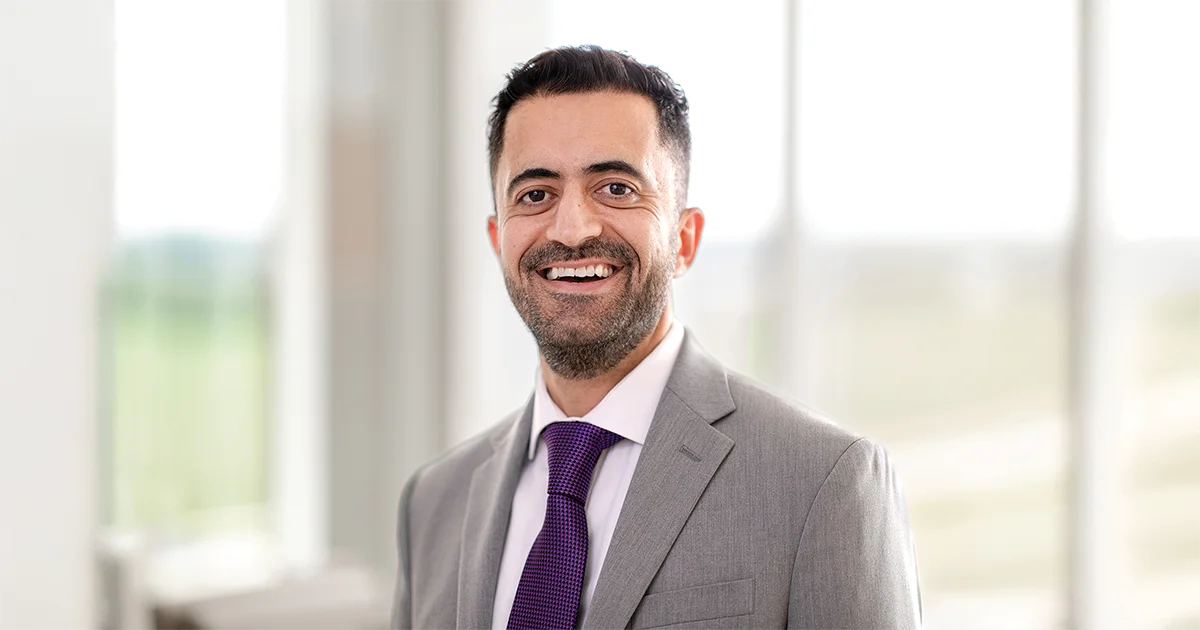
When Erfan Mojaddam. Ed.M., first saw the job posting for chief information officer, he wasn’t looking for just another step in his career. He was looking for a place where he could make a lasting difference.
“I thought it was an opportunity for me to bring my experience in higher ed and in a medical school and make an immediate impact,” he says.
Mojaddam has moved to Iowa and starts his new role at DMU in September 2025. He brings with him a global perspective on educational technology. He has significant experience in the health sciences. And his leadership philosophy is grounded in empathy, equity and trust.
A Global Foundation
Before he ever stepped into a university role, Mojaddam began his professional life as an aerospace engineer. A formative experience during his final year of college — Semester at Sea — planted the seeds for something different. Through the experience, he spent a semester sailing around the world and visiting 11 other countries. One of the RAs onboard had just returned from the Peace Corps, and he was so inspired by her story that he decided to apply.
He was accepted and sent to Namibia, where he taught math and science in a rural village and partnered with a nonprofit organization called SchoolNet, which provided computers and internet access to underserved schools. “That was my first experience in educational technology,” he shares. “We barely had enough textbooks, and now students had access, really, to the world” through antenna-based internet access.
That spark led him to Harvard University, where he earned a master’s degree in technology, innovation and education and began carving a career in educational technology.
Bridging Worlds at Stanford and Berkeley
Mojaddam’s work since then has taken him from K-12 education to elite universities, including leadership roles at Stanford University School of Medicine and the University of California at Berkeley.
At Stanford, he led the technology efforts for a project called Digital Medic — an ambitious global health initiative that localized Stanford’s health education content for use in low-resource settings.
My team built an app that was designed for areas where there’s very limited internet bandwidth, where people don’t have access to the latest phones,” he says. The team worked closely with partners to translate and adapt the content culturally, launching programs with governments, nonprofits and health systems across more than 190 countries, including a maternal health campaign in South Africa focused on breastfeeding education.
The experience blended all of his passions: technology, teaching, equity and collaboration.
At Berkeley, Mojaddam has served as deputy chief academic technology officer for five years. There, he has led efforts to expand immersive learning, develop data-informed teaching tools and ensure that student voices are heard. One of his most innovative projects has been helping faculty visualize student performance trends using previous years of course data in the learning management system. The effort will enable better curriculum design and equity-focused interventions.
“I believe in the power of data, but only if we make it usable,” he says. “It’s about giving faculty and administrators the tools to see what’s working and finding where students might need more support.”
He played a key role on Berkeley’s Student Technology Council, an advisory group that meets monthly to give feedback on new digital initiatives and share insights about the student tech experience.
“This has been a really good opportunity to make sure that student voices are heard,” Mojaddam says. “We get student feedback on how things are going, what’s not going well, what’s missing, and how we can implement tech solutions that will help their experience as students.”
Drawn to a Vision
When Mojaddam visited DMU’s campus in West Des Moines, he quickly realized this was more than just a professional opportunity. It was a cultural fit.
From the simulation center to the openness of the leadership team, “I was impressed,” he says. “This is one of the more forward-thinking academic environments I’ve experienced.”
He was equally impressed by DMU’s information technology staff. “Carolyn has done a great job creating a passionate workforce and has put processes in place to support the campus for growth,” he says. “That’s not something you always find in higher ed.” (Read more about Carolyn Weaver.)
President and CEO Angela L. Walker Franklin, Ph.D., says Mojaddam’s leadership style and background made him an ideal choice to help guide DMU’s next era of digital strategy.
“Erfan is a collaborative and visionary leader,” Franklin says. “His global experiences, technical expertise and respect for people make him well-equipped to help DMU enhance our technology in service of our academic mission.”
People Are a Priority
Although Mojaddam brings strong credentials in AI, data strategy and immersive learning, he’s clear that his first priority will be people.
“In my first months at DMU, I’ll be focused on listening, understanding what’s working, where there are gaps and how we can help everyone at DMU.”
He plans to build strong bridges between IT and academic departments. “One of the biggest challenges I’ve seen in higher education is a disconnect between IT and academics,” he says. “But when those two areas collaborate, amazing things can happen.”
What’s Next: AI, Data and Immersive Learning
Mojaddam says DMU is well-positioned to embrace the next wave of educational innovation.
Among the areas he’s excited to explore:
Artificial Intelligence
“Generative AI has been around for about two and half years now. Although important questions remain, its emerging use among students is undeniable. It’s the right time to set guidelines, create literacy on opportunities and challenges for students and explore responsible and impactful ways to integrate it into clinical education and clinical care.”
Data Stewardship and Insights
“Every decision we make can be improved with data. How can we make use of it to generate insights that help our campus leaders make more informed choices?”
Immersive Learning
“The DMU simulation center is world-class. How can we expand those capabilities with virtual and augmented reality to help students prepare for real-world clinical experiences? How do we bring the clinic to them in the classroom?”
Mojaddam and his wife, Karen, have relocated to Des Moines.