
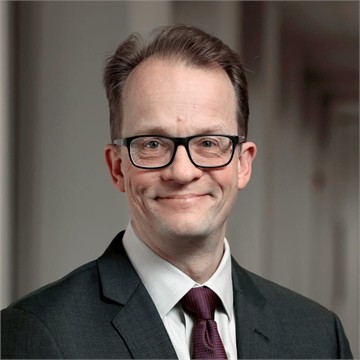
Robert Good, D.O.’77, MACOI, and his wife, Brenda, have built a life rooted in partnership, purpose and generosity.
They met in a plant physiology class (get that rooted reference now?) at the University of Northern Iowa, where Bob was studying biology and chemistry, and Brenda was majoring in math. They were lab partners — and partners in life from that moment on.
“She helped me with calculus, and I helped her through that upper-level biology class,” Bob recalls. They married a few days after graduating in 1974 and moved to Des Moines so he could pursue his dream of becoming a physician at what is now Des Moines University Medicine and Health Sciences.
Those early years weren’t easy as they balanced work, school and the start of their family. They lived modestly across the street from campus, both working at a restaurant and relying on tips to make ends meet, while Brenda pursued a math teaching career that later shifted to finance and management. After Bob completed his medical training, he served patients across rural Iowa and Illinois. Along the way, they raised three daughters, now enjoy 10 grandchildren, continue to mentor students and are committed to helping others — and always make time for a bit of golf.

An Innovative Gift to Education
Longtime supporters of DMU, the Goods recently established the Dr. Robert and Brenda Good Faculty Development Academy. The academy is a forward-thinking program designed to strengthen the heart of medical education: the faculty who shape tomorrow’s providers.
“Education is about innovation,” Bob says. “Just like in medicine, you have to constantly keep up, learn and give students the tools they need to truly understand, not just memorize.”
The academy helps DMU faculty grow in six core areas to:
- Enhance new faculty onboarding and integration.
- Provide continuous professional growth.
- Create collegial collaboration and support.
- Advance strong teaching skills.
- Encourage educational research.
- Strengthen preceptor and clinical educator development.
The academy brings together initiatives like faculty orientation, peer mentoring, exam-writing workshops, the step-back consultation model and funding for professional development at conferences. New programs like the Insights Forward reflection initiative allow attendees to bring back fresh ideas to share with the DMU community. Longstanding efforts — like themed speaker series and preceptor training — are elevated under the academy’s unified vision.
The academy doesn’t just empower educators with advanced teaching tools, it creates a culture of innovative excellence. This initiative gives faculty “permission” to experiment, try new approaches and conduct research about effective education models.
“This is a hub for excellence and impact,” says Nehad El-Sawi, Ph.D., who leads DMU’s Office of Academic Innovation and Enhancement. “We’re empowering educators in all stages of their careers. Whether it’s a new faculty member just starting out or a seasoned professor looking to try something new, the academy offers support that makes a real difference for them and their students because when we invest in our educators, we are investing in better outcomes for our students.”

Physician assistant faculty member Laura Delaney, B.S.P.A.’99, M.S.P.A.S., PA-C, is one of many who have already seen the difference. With help from the academy’s step-back consultation model, she transformed her research into a poster presentation for the National Physician Assistant Education Association conference.
“As a clinician, I wasn’t trained in research,” Delaney says. “This program gave me the structure and encouragement to see that I had something to contribute. It pushed me forward.” Now, the next step for her is to begin writing and publishing a paper based on her findings.
The step-back consultation gave me accountability, encouragement and the sense that my ideas had value. I never thought I’d end up presenting at a national conference, but I did.”
Laura Delaney, B.S.P.A.’99, M.S.P.A.S., PA-C
Associate Professor and Director of Clinical Education in the Master of Science in Physician Assistant Studies Program
Delaney’s study looked at whether shortening clinical rotations in pediatrics and women’s health from four weeks to two weeks would impact student outcomes. These rotations are hard to secure due to limited preceptor availability and high demand. Her data showed that students performed just as well in shorter rotations and that the shorter model benefited students and eased the burden on clinical sites.
Faculty also benefit from the academy’s ability to attract prominent guest speakers and thought leaders in education on topics like AI, active learning and innovative teaching models.
“This keeps us on the leading edge,” says Martin Schmidt, Ph.D., professor of biochemistry and nutrition, who is an active participant in faculty development programs. “We’re building a culture of innovation and excellence, and the academy is at the center of that.”
A Mission Beyond Measure
For the Goods, that’s exactly the point.
“We wanted to do something that would last,” Brenda says. “The students we support today will be the ones caring for us and our communities tomorrow.”
Bob adds, “This is about multiplying the mission. Faculty influence students, students impact communities and healthier communities serve society. We have to teach differently than we did in the past because everything is changing. Innovation may not always mean something new. It might mean doing something old in a new way.”
His own experience as a leader at Carle Illinois College of Medicine shaped that belief. There, Bob has helped develop an interdisciplinary program that combined engineering with medicine to rethink health care education. He led a founding curriculum committee made up of five scientists, five engineers and five physicians to reimagine how to train students for tomorrow’s needs. That experience inspired the gift to DMU for the academy.
As part of the Purple & Proud campaign, the Goods also supported the Robert and Brenda Good Active Learning Practice Laboratory in the Edge of Advancement.
“Through that gift, we started thinking, ‘How do we develop future contributions?’” Bob says. “It grew from there.”
The Dr. Robert and Brenda Good Faculty Development Academy Includes:
- Preceptor Development Series
- Themed Independent Faculty Development Sessions
- National/International Selected Series
- New Faculty Orientation Program
- Communities of Practice Program
- Online Faculty Development Courses
- Insights Forward: Conference Reflection Program
- Step-Back Consultation
What Happens in a Step-Back Consultation?
The step-back consultation is one of the many signature offerings of the Dr. Robert and Brenda Good Faculty Development Academy. It’s designed to help faculty grow their teaching and research skills in a supportive environment.
- A faculty member brings an idea — maybe a classroom challenge they want to solve or a research question they are trying to explore
- They explain the idea to a small group of peers from different DMU programs or specialties. These peers don’t have to be experts in the topic, just curious, thoughtful colleagues.
- Then comes the step back. The presenting faculty member steps back and stays quiet while the rest of the group discusses their idea. They talk about what they heard, ask questions, suggest directions and reflect on what’s possible.
- The presenter listens and gains new insights. Without having to respond in the moment, they can really hear what others are saying. It’s often eye-opening to see how others interpret your project or see possibilities you hadn’t considered.
- The group continues to meet regularly. Over time, the members support and celebrate each other’s growth.