

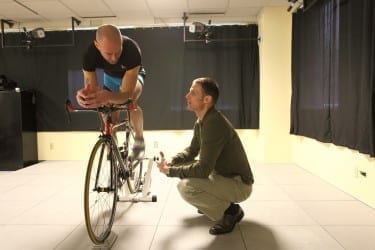
As cycling season kicks into high gear, it’s important to slow down and think about bike safety. While accidents are the number one source of bicycle-related injuries, improper bike fit is a common cause of back, knee, neck, wrist and hand problems. Before you hop on your bike for a training ride or race, it’s important to re-evaluate your bicycle fit.
Finding the right fit
Proper bike fit minimizes discomfort, increases efficiency and helps prevent injury, but finding the right fit can be difficult. While research supports certain aspects of bike positioning, bicycle fitting is not an exact science. Each person’s body is different, so the same parameters for one rider may not work for another. Fortunately, bikes come in varying sizes with adjustable parts to allow for minor accommodations to suit an individual’s unique characteristics. When adjusting your bike, consider these three factors:
- Foot alignment – Correct placement of your foot on the pedal improves leverage and reduces the risk of knee injury. The ball of your foot should be positioned on the middle of the pedal and oriented so that the knee tracks in alignment with the ankle and hip.
- Seat height – Seat height affects the legs’ ability to produce power and is often the source of knee and hip pain. A good rule of thumb for finding your optimal seat height is to achieve between 25 and 35 degrees of knee bend when the foot is at the very bottom of the pedal stroke when you ride.
- Handlebar position – The position of your handlebars affects hand, shoulder, neck and back comfort. Proper handlebar position is much more variable and very dependent upon back, neck and shoulder function in addition to the type of bike.
Adjusting for performance
Biomechanically, the body performs better when the joints are aligned at certain angles and the muscles are in position to produce maximum force. Experienced riders can feel an increase in comfort and efficiency in even the slightest adjustments. Using biomechanics, you can position yourself to produce efficient movement and improve performance. Yet, due to individual variability, the optimal fit biomechanically does not necessarily lead to better results. Posture, flexibility, muscle performance, previous injuries and medical conditions are also important considerations that will help you find the ideal fit.
Seeking a professional opinion
Joint angles, biomechanics, incremental adjustments — it can all be very confusing, making fitting a bike difficult to do on your own. Fortunately, most bicycle shops offer fitting services. They will take measurements, standardize foot position and use specific analysis procedures to help find the best fit for each person.
If an injury, medical condition or recurring pain is affecting your cycling, you may need to consult a licensed health care professional. Physical therapists are experts in movement function and can help in the rehabilitation of cycling-related injuries, including proper bike fit. A physical therapist can help identify specific body and movement dysfunctions that can be considered in the bike fit to allow a comfortable and pain-free while reducing the chance of further injury.